The UN conference needs a pledge on tariff governance
Unwillingness to increase tariffs regularly makes utilities uninvestable. The water sector needs governments to commit to regular, rules-based tariff increases.
Tallulah Lutkin
16 November 2026
In 2026, 38% of cities surveyed in the Global Water Tariff Survey did not change their tariffs compared to the year before. That lack of increase is particularly pronounced in developing markets: of the utilities that increased their tariffs in 2026, less than 20% also did so in 2025 in Southern Asia and Sub-Saharan Africa; in Europe and North America, it's more than 80%.
The Tariff Survey often highlights the divide between higher-income regions with high, regularly increasing tariffs and lower-income regions where tariffs don't cover costs and increases come as five-year hikes. The upcoming UN Water Conference seeks to home in on financing: discussions around tariffs, and how to increase them, should be at the heart of the debate.
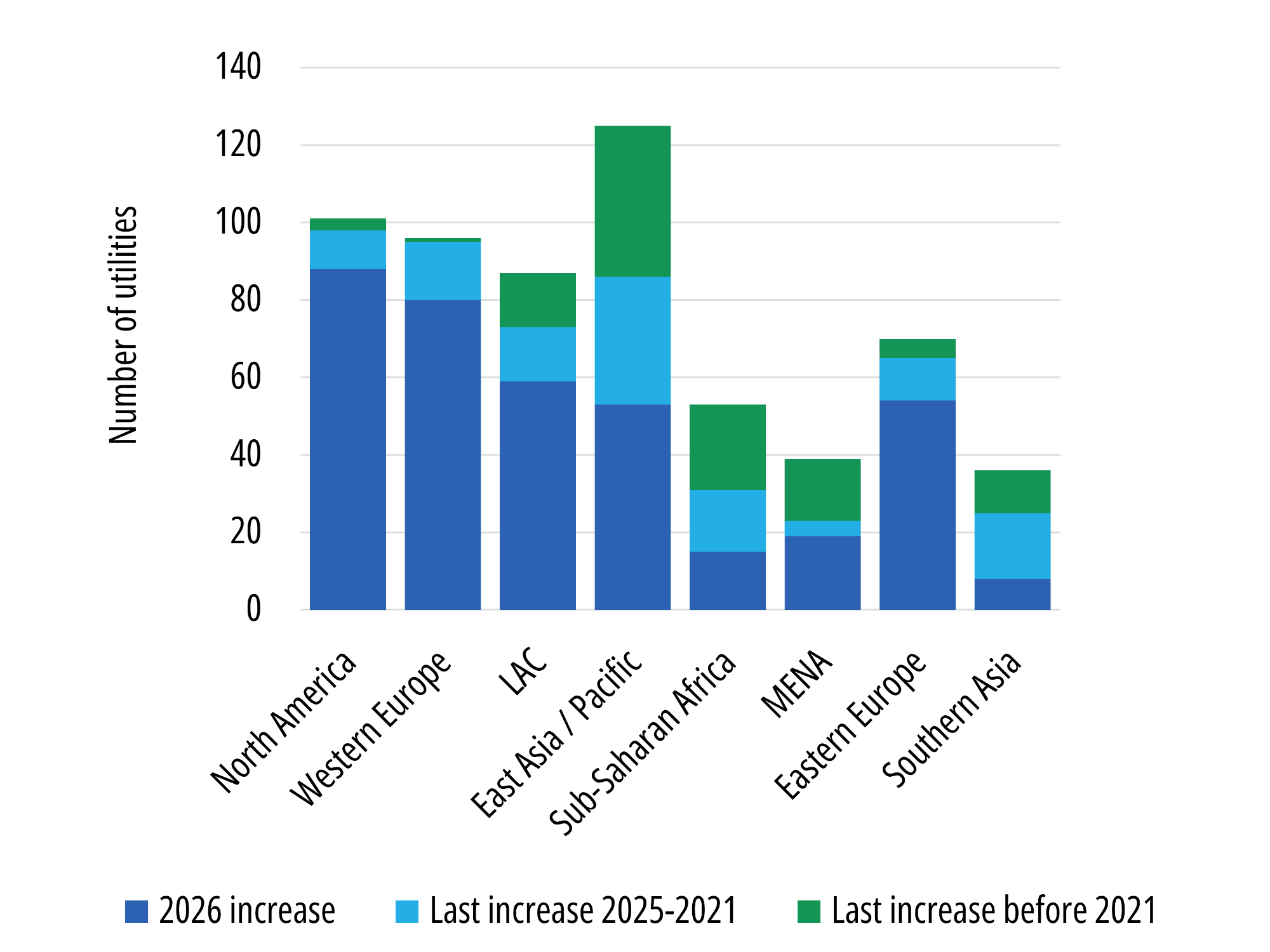
By and large, utilities in North America and Europe increase their tariff every year. In lower-income countries however, tariff increases are far less frequent (and often much larger when they do happen).
Source: 2026 Global Water Tariff Survey, GWIThe answer isn't as simple as "just increase tariffs to meet cost recovery". Firstly, utilities often do not set tariffs themselves, politicians and regulators do. Misaligned objectives between utilities and those who set tariffs (for example, politicians keeping tariffs low to win votes) hinder a culture of regular increases. In 2026, half of the top highest decreases in the Survey were due to local politicians or national governments imposing decreases, despite utilities clamouring for more revenue. Secondly, large increases every ten years in an attempt to "catch up" foster customer resentment and investor mistrust. In 2023, the Punjab region of Pakistan, where some cities hadn’t increased tariffs since the early 2000s, suddenly imposed increases between 200% and 500%, causing upset across the region. Tariffs have not increased there since.
How can a utility expect to become bankable if its revenues cannot be guaranteed by regular, predictable tariff increases? Rather than trying to increase tariffs any way they can, utilities and governments must focus on creating a framework for good tariff governance that takes a holistic and coherent view of when and why tariffs should increase. This is reassuring to investors and less daunting for customers.
Such frameworks can also help maintain affordable social tariffs. Malaysia's sewerage utility Indah Water Konsortium (IWK) completed a multi-year tariff increase in 2026, raising tariffs by 92% over four years. Thanks to a cross-subsidy system between its domestic and commercial tariffs, the utility has achieved cost recovery even though domestic customers currently pay less than it costs to serve them. IWK is a great example of a tariff governance success story: a clear, multi-year regular increase scheme, buy-in from regulators and stakeholders, and a commitment to affordability for customers.
We know that social tariffs and affordability schemes ultimately increase tariff collection: customers who trust their utility to provide fair tariffs and good service are likely to pay (and usually much less for utility services than alternative providers). Despite what may be heard, the lack of tariff increases stems from an unwillingness to charge, not an unwillingness to pay. What's more, social tariffs provide political cover for governments worried about voter backlash.
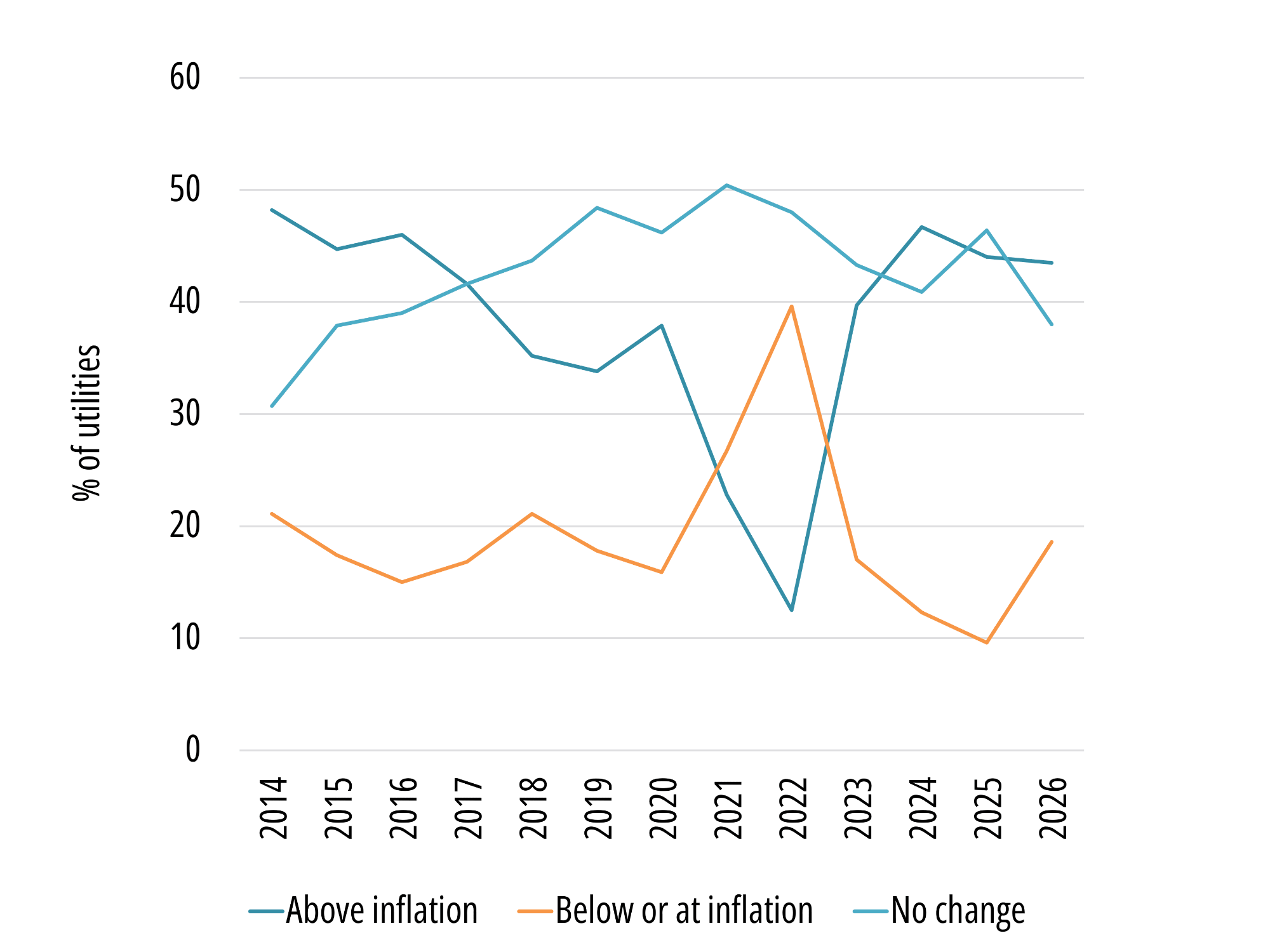
Every year, around 40% of utilities do not increase their tariffs at all, whilst another 20% or so push adjustments below inflation, which means nearly half of utilities experience tariff decreases in real terms.
Source: 2026 Global Water Tariff Survey, GWIAttracting investors and lenders is not just a numbers game, it is about having frameworks and governance in place to guarantee an acceptable risk level. The UN delegates need to look at tariff governance as a financing tool, because blended finance and guarantees mean little if almost 40% of utilities won't increase their tariffs.
So what I want to see come out of the UN Water Conference this year is a governance framework that governments can use as a guide to create a fair, rules-based system for utility tariffs. Whether it's finding the right tariff structure for their customer base, implementing regular increases or improving tariff collection, empowering utilities to have the tariffs they need is the best step the water sector can take to improve its financial sustainability.
GWI’s 2026 Global Water Tariff Survey was published on 15 October; it covers water, wastewater and stormwater tariff profiles for 1,069 cities in 189 countries, with 431 cities added this year.